|

Home
Books
Peter Miller
Race Route
Email
|
|
"To
me, the Mille Miglia was the finest road
race of them all. But although I loved it, I was always afraid, because
of the very high speeds"
Sir
Stirling Moss in his preface to Peter Millers
autobiography of Conte Maggi, the legend behind the race

Please
note: This site will be regularly updated and improved, please call back.
The Mille
Miglia
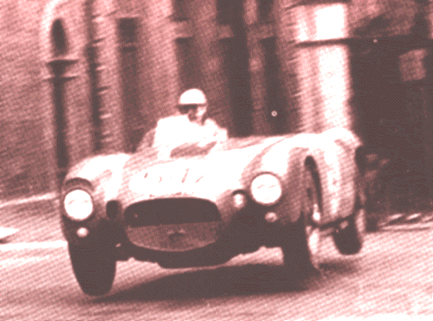
High speed shot taken during
the 1954 Mille Miglia, Driving a 6 cylinder
3300 cc Lancia, Truffi who had led the field at Rome, with
a 4 minute advantage on team-mate Ascari, but crashed at Vetralla. Pictured
in the Lancia , all four wheels airborn
The Mille Miglia
is perhaps the worlds most grueling test of endurance, stamina, it was
dangerous and demanded the utmost in driving skill. It was not just the winning but the taking part, which counted, as Maggi himself delighted in saying. The excitement of the race was felt not only by the drivers but also by the spectators. It was a shared passion. Attracting some of the best international drivers of the day and up to 450 drivers of lesser merit and experience, it is estimated that more than 12 million race fans, the 'tifosi', lined the route round half of Italy in a continuous furore of excitement. They stood in the road and barely jumped clear at the last moment. The German Mercedes driver, Karl Kling, describes how he took a right-hander during the 1955 race: " I found the road was nearly completely covered with spectators who were trying to get a better view of the drivers. As they all ran off the road, one of them cut right across me: in order to avoid him I ended up in a ditch. It isn't easy to race with so many people at the roadside"
Peter Miller describes
the men, their machines and the struggle for the only thing that matters:
Winning. An Englishman who's lifelong passion has been the Mille
Miglia, will tell the story from the cockpit to the stalls. Peter has
witnessed many of the fascinating events that shaped the Mille Miglia,
here he gives his insight into what is considered the greatest road race
ever. Not just a race, a way of life. Follow this exclusive interview
with Peter Miller, who has finally been persuaded to re-publish his classic
work on the legend behind the race: Count Maggi. The work is entitled
Conte Maggi's Mille Miglia
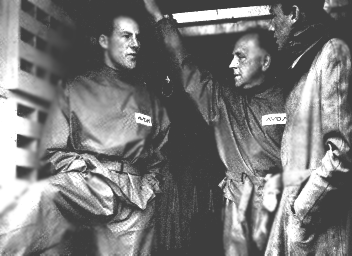
Stirling
Moss (left) and Parnell (center) discuss the "pot of
Count
Maggi's 1000 Mile dream:
The
beginning.
Since 1905, Brescia had established a reputation for aviation, cycling, ballooning, motorcycling and automobile racing. In 1921, the first Italian Grand Prix was held on the 90 mile Fascia d'Oro circuit of Montechiari. Maggi, then nineteen, watched the Frenchman, Jules Goux, win the race in his Baillot. This caused an uproar in the Italian Press and there was fierce criticism of the Italy's faltering automobile industry. By the following year, Milan had stolen the Grand Prix from the Brescia with the completion of the Mercati's Monza autodrome circuit. This deception was never forgiven by the Brescians.
In late November 1926, after winning an important hillclimb, Maggi began to realise his dream of restoring Brescian pride and instituting a motor race that would be unique. On his return home he met his friend, Renzo Castagneto, Count Franco Mazzotti and Giovanni Canestrini, the motoring and aviation correspondent for the important Milanese newspaper, the Gazzetta dello Sport. An historic meeting followed. As the 'four musketeers' argued through the night, Maggi stated that, "there are no Italian cars available and to win races we have to buy foreign cars. There are no events and it seems our old traditions are slipping away. We must do something urgently!"
It would have to be a road race because of Mercati's circuit race syndicate, and such a severe test of cars and drivers that it would capture public imagination. A tour of Italy and an Alpine cup race were rejected, as was a Brescia to Rome road race, since it was felt that Rome would take all the glory. Then someone suggested Brescia - Rome - Brescia in a single stage. Mazzotti sat up and asked how far that would be, to which Castagneto replied "about 1600 kilometers". And Mazzotti, who was a pilot was accustomed to measuring in miles, said excitedly, "That's one thousand miles. Why don't we call our race the 'Coppa delle Mille Miglia'." With a shout all four agreed and the Mille Miglia was born.
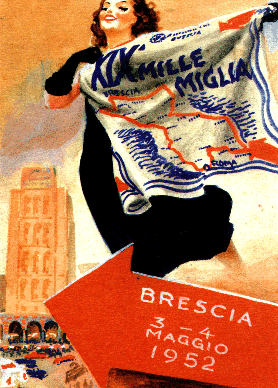
Poster promoting 1952 Mille Miglia
back to top
"The Mille Miglia Cup to be held during the weekend of March 26/27 1927 will be the most important manifestation of Italian motor sport ever". Canestrini, Gazetta dello Sport.
Maggi, then only 23 years old, proposed that the new race should be Brescia's sole responsibility and that an automobile club of Brescia should be formed. Franco Mazzotti readily offered to finance the race and accepted the presidency of the club. Castagneto, already a seasoned sporting event organiser, became its permanent Director General. Canestrini promised to promote the new race in his newspaper and it was, in his prophetic announcement, "to be the most important manifestation of Italian motor sport ever."
The immediate reaction was an avalanche of protest, mainly on the grounds that it would be impossible to administer a race of such magnitude, with the route passing through hundreds of communities, all of which has civil leaders to cajole. When deadlock seemed certain, Silvio Crespi, President of the Italian Automobile Club, wrote a letter to Mussolini's right hand man, Agosto Turati, a Brescian by birth. Since Maggi, acting as chauffeur, had once saved Turati from assassination as he was leaving the Teatro Grande in Brescia, it was decided that Maggi should personally deliver Crespi's letter. Turati, who was a canny a politician and too much of a sports man to fail to see the importance of such a prestigious race, readily gave his approval for the Mille Miglia to be held as scheduled and for the necessary liaison between the police, the army and the civilian authorities.
From the hesitant start, the Mille Miglia became the race to win, and every year produced some particular act of heroism, which guaranteed banner headlines. The race was first banned in 1938 after a serious accident when a Lancia skidded on tramlined. Undeterred, the race was run again in 1940 on the old Chiari circuit outside Brescia. It was won by von Hanstein in a BMW after Maggi had driven to Berlin to get special dispensation from the German High Command. Post war, the next Mille Miglia was run in 1947, on the battle scarred roads, with hidden mines and countless broken bridges to negotiate.
By then, the Club 1000 Miles had been formed to keep a full documentation of every driver and passenger participating and membership rules were explicit. The 'Silver Fox', Piero Taruffi, for example, who won the last Mille Miglia for Ferrari in 1957 at his fifteenth attempt, is only shown in the record to have finished five times. His other ten attempts over 27 years did not count, as he did not complete the circuit. Taruffi said after his victory, "When I won the Mille Miglia, I understood that I would never have changed my career for the one of any other champion. The Mille Miglia is a race that takes hold of your heart yet also rips the strength out of your body: a unique race that cannot be substituted."
Maggi, the nobleman who created a racing legend
This extraordinary Brescian Nobleman, whose ancestors were among the original Venetian merchants with a Vatican licence to mint their own coinage and raise an army in the times of war, learnt to drive horseless carriages while a schoolboy sitting on the knees of the family chauffeur. Both he, and his best friend Count Franco Mazzotti, worshipped speed, and both became racing drivers, although Mazzotti achieved world fame as an intrepid, record-breaking pilot. In early 1942, as commanding officer of secret Italian air strike commando unit, Mazzotti's plane went missing somewhere off the coast of Sicily. When the Mille Miglia was restarted in 1947, Maggi, devastated by his friend's death, renamed the race the 'Coppa Franco Mazzotti' in his honour.
With each successive year, the event attracted more glamour and race speeds rose dramatically, which the authorities viewed with growing concern. Given the speed that were being reached and the lack of roadside barriers, it was inevitable that the Mille Miglia could no longer continue within the acceptable safety parameters. It had always been a race about speed. Maggi said himself, "In motor racing the one who goes fastest must win. He who gets rid of his inhibitions will always beat the one who lifts his foot. Motor sport is like that. The Mille Miglia has always been like that and will never change. Can you imagine the Mille Miglia being other than a race of speed."
The race ended in 1957 when the Ferrari driven by the Spanish nobleman, the Marquis Alfonso de Portago somersaulted into the crowds at the exit of a small village called Guidizzolo. Not only were de Portago and his American journalist killed, but so, tragically, were 10 spectators, including children. Three days later, the Italian government banned Maggi's race forever.
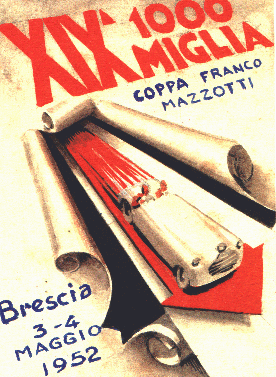
Poster promoting 1952 Mille Miglia back
to top
The legacy of Count Maggi's dream
The Mille Miglia was epoch-making. It revived the Italian automobile industry and gave birth to the grand touring cars, which are now sold, all over the world. It proved that by racing over open roads for 1000 gruelling miles in adverse weather at average speeds of nearly 100 mph, there were priceless technical reasons to be learnt by the petrol and oil companies and the brake, clutch, electrical, lighting and transmission manufacturers. Commendatore Ferrari concluded that without the Maggi's race, "my grand touring cars would never have reached such a peak of perfection for twenty five years."
The Mille Miglia brought together the automotive elite once a year. Maggi and Castagneto worked through the war, fog, rain and scorching heat to make it the most prestigious race ever run. But even they could never have predicted the roll call of drivers who would win their victor's laurels over the dusty Italian roads in those thirty years: Minoia Campari, Nuvolari, Carraciola, Borzacchini, Varzi, Brivio Pintacuda, Biondetti, von Hanstein, Marzotto, Villoresi, Bracco, Ascari, Moss, Castellotti and Truffi.
If the Mille Miglia is not to settle under a cloud of dust and its ghosts laid to rest forever, we must always remember how much we owe to the men who characterised those thirty memorable sporting years. Maggi died within four years of this last, ill-fated Mille Miglia, a broken man at the loss of his beloved race. " For Maggi," said Castagneto "the Mille Miglia represents a way of life and the ideal which determined his every action".
Sales & Info info
Webmaster Dee
|
 Mille Miglia